- Home
- About Company
- Our Products
- Brochure
- Career
- Gallery
- Contact US
Belt Conveyors
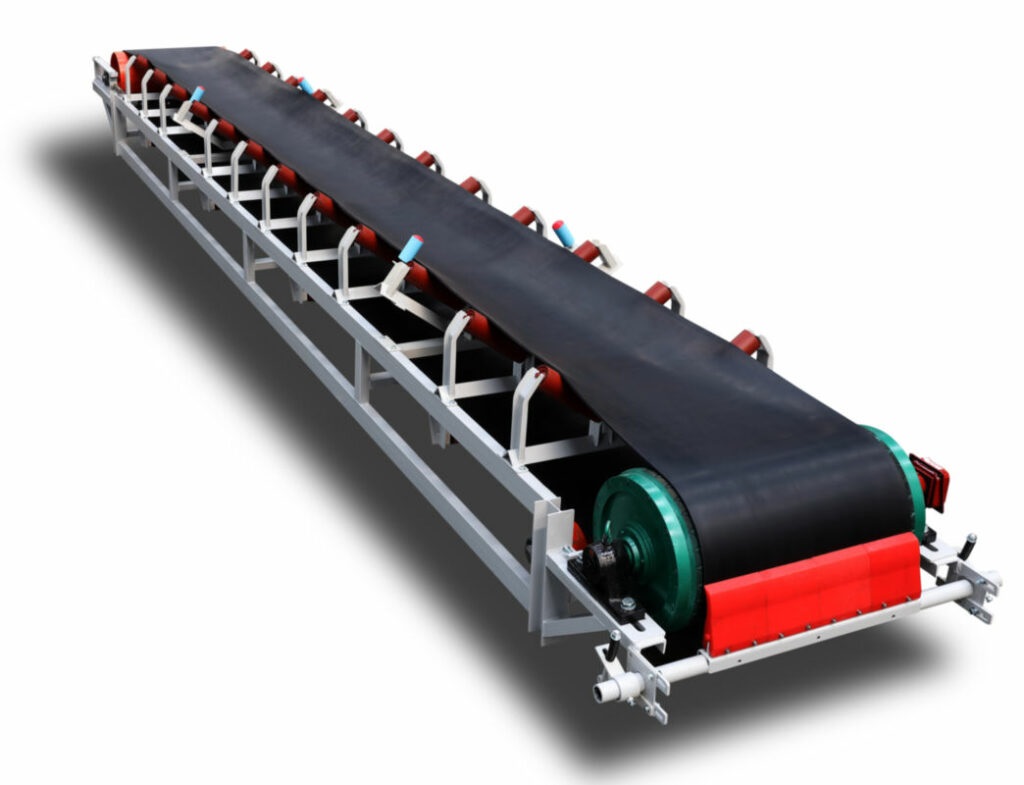
A belt conveyor is a mechanical system that moves materials using a continuous loop of flexible material, or belt, stretched between two pulleys. A motor-driven pulley rotates, causing the belt to move and transport items placed on it from one location to another. These systems are widely used across many industries for their ability to move heavy or bulk materials quickly, including in manufacturing, mining, and food processing.
Key components and function
-
Belt:
An endless loop of flexible material (like rubber, fabric, or plastic) that carries the load.
-
Pulleys:
Two or more drums that support and guide the belt. At least one pulley is a drive pulley, powered by a motor to move the belt.
-
Rollers or slider bed:
These support the belt as it moves, helping to maintain its shape and allowing for continuous motion.
-
Motor and drive mechanism:
The power source that rotates the drive pulley and moves the belt.
-
Frame:
The structure that holds the entire system together and supports the belt and pulleys.
How it works
- A motor powers a drive pulley, which rotates the pulley and the belt.
- The friction between the drive pulley and the belt moves the belt along with it.
- Materials are placed on the belt at the loading area and are carried along until they are discharged at the other end.
- A tension roller at the other end keeps the belt tight.
Benefits and applications
-
Efficient material handling:
Automates the process of moving goods, reducing the need for manual labor.
-
Versatility:
Can move a wide variety of materials, from light-packaged products to heavy bulk items, and can be used for both incline and decline transport.
-
Increased productivity:
Enables faster movement of products and consistent workflow, which helps meet production targets.
-
Common uses:
Found in industries such as manufacturing, food processing, mining, warehousing, and airports.